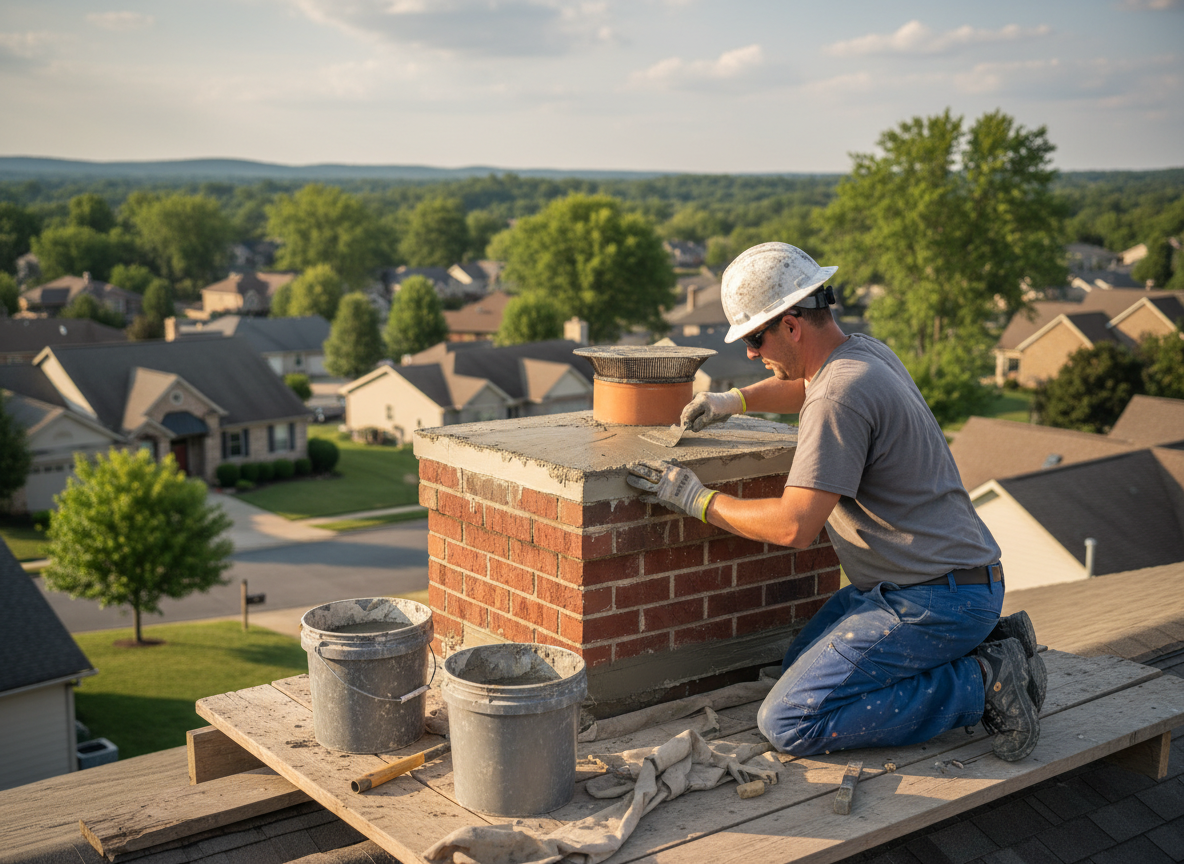
Chimney crowns in Blue Ash homes take constant abuse from Ohio weather cycles. Most crowns here are poured concrete over brick flues built in the 1960s through 1980s subdivisions off Plainfield Road and Kenwood Road. When the crown develops hairline cracks, water enters the flue liner and saturates the brick, then freezes and expands. This spalling accelerates fast once winter temperatures drop below freezing at night and thaw during the day. We mix a high-strength, fiber-reinforced mortar that matches the thermal expansion of the original flue and slope the new crown surface to shed water instead of pooling.
Edge cases appear on two-story homes near the Blue Ash Nature Preserve where tree canopy keeps the chimney shaded and damp longer after rain. In those situations the crown mortar never fully dries before the next storm, so we install a stainless steel drip edge and a breathable masonry sealer rated for 15-plus years. Hamilton County inspectors look for proper clearance to combustibles and correct flashing integration when any crown work is done; skipping the step where the new crown overlaps the existing step flashing by at least two inches is the most common reason for re-inspection.
Homeowners sometimes try to patch only the visible crack with standard caulk. That fails within one season because caulk cannot handle the movement between the crown and flue tile. We always remove the damaged concrete back to sound material, install new rebar if the original crown was thin, and tool the edges so water cannot sit against the brick. The job finishes with a 48-hour cure before any rain is expected so the mortar reaches full strength.
Technician insight
In Blue Ash, the thing that catches most people out with chimney crown repair is how the flat crowns on 1970s brick chimneys in the neighborhoods around Plainfield Road hold water after every spring rain, then freeze at night and pop the mortar joints within two seasons.
Leaking Crown on Two-Story Home
Problem: Water stains appeared on the living room ceiling after heavy rain. What we found: A cracked crown on a 1978 brick chimney with water tracking down the flue into the attic. What we did: Cut out the damaged concrete, poured a new sloped crown with drip edge, and sealed the masonry. Outcome: No further leaks during the next several storms and the homeowner avoided flue liner replacement.
How it works
- 1
Site Inspection
We examine the crown, flue, and flashing from the roof and ground, checking for cracks, spalling, and water staining inside the attic.
- 2
Damage Removal
Loose and cracked concrete is cut away until only sound material remains, exposing the top of the flue tile.
- 3
New Crown Pour
A reinforced concrete crown is formed with the correct slope and a drip edge, then finished with a tooled joint at the flue.
- 4
Sealing and Cleanup
After curing, a masonry sealer is applied and the work area is cleared of debris before we leave the site.
Pricing
Cost depends on roof access, crown size, and extent of flue damage. Upfront quotes provided after inspection.